Entrepreneurship in Context: Empowerment and Co-creation

This BIP is aimed at Bachelor’s, Master’s and PhD students from all disciplines who are interested in critically exploring inclusive and sustainable entrepreneurship within contemporary innovation systems. It is organised by University of Münster, in cooperation with Haaga-Helia University of Applied Sciences, MCI – Management Center Innsbruck, and Technical University of Košice (TUKE).


Please be aware that your home university may set a different application deadline depending on their internal selection process.

Registration dates 28 March 2026 31 July 2026
Course dates 14 September 2026 18 September 2026
Registration is open
Entrepreneurship in Context: Empowerment and Co-creation

Course Outline

This Blended Intensive Programme (BIP) provides students with a critical and advanced understanding of inclusive entrepreneurship within contemporary innovation systems. Adopting an interdisciplinary perspective, the programme situates entrepreneurial activity within its socio-economic, cultural, and institutional contexts, highlighting how power relations, inequalities, and structural conditions shape entrepreneurial opportunities and outcomes. Combining virtual collaboration with an on-site phase at the University of Münster, the BIP integrates academic input, interactive learning formats, and practice-oriented engagement. Students will explore inclusive and sustainable innovation practices, critically examine structural barriers and unequal participation in entrepreneurship, and participate in co-creation processes that emphasise diversity, reflexivity, and shared responsibility.

Designed as an empowerment-oriented experience, the BIP is primarily aimed at Bachelor’s, Master’s, and PhD students from diverse social, cultural, and academic backgrounds, explicitly welcoming participants from all fields of study. The programme brings together an international and interdisciplinary teaching team from the Ulysseus European University alliance. Designed as a compact yet academically rigorous experience, it comprises preparatory online sessions, an intensive on-site phase, and a structured follow-up component. Across these elements, students engage in guided academic input, collaborative project work, independent preparation, and reflective tasks. The overall scope of contact hours and structured self -study aligns with the workload typically associated with a 3 ECTS course within the European Higher Education Area. Upon successful completion of all components, including the final project presentation, participants receive a certificate outlining the achieved learning outcomes and d ocumented workload to support recognition at their home institutions. Participants are responsible for arranging adequate health insurance coverage for the duration of their stay in Münster.

Course Content

The BIP addresses inclusive entrepreneurship within contemporary innovation systems from a critical and interdisciplinary perspective. Core topics include structural inequalities, power relations and institutional conditions that shape entrepreneurial opportunities and participation.

The programme explores inclusive and sustainable innovation practices, examines barriers to access within entrepreneurial ecosystems, and analyses the socio-economic and cultural contexts in which entrepreneurial activity is em bedded. In addition, students engage with concepts of diversity, reflexivity, positionality and shared responsibility in co -creation processes, culminating in the development of a small-scale inclusive innovation project.

Learning Outcomes

Upon successful completion of the BIP, students will be able to:

1. Analyze entrepreneurship and innovation systems from a critical perspective: Identify and critically assess structural barriers, inequalities, and power dynamics that influence participation and inclusion in entrepreneurial and innovation ecosystems.

2. Apply principles of inclusive and sustainable innovation: Conceptualize and reflect on entrepreneurial approaches and business models that integrate economic viability with social inclusion and sustainability considerations.

3. Collaborate effectively in diverse and transnational learning environments: Engage in inclusive co -creation processes, contribute to safer and braver learning spaces, and demonstrate reflexivity regarding their own positionality, assumptions, and agency in entrepreneurial context.

4. Develop and collaboratively refine a small-scale inclusive innovation project and present its conceptual foundations, contextual relevance, and potential impact in a final project pitch.

Requirements

This course is aimed at Bachelor’s, Master’s and PhD students from all disciplines. No prior knowledge of the subject is necessary; the course is designed to provide all essential theoretical foundations and contextual background required for active participation. The language of instruction is English, and participants are required to have a minimum proficiency level of B2.

Physical Mobility

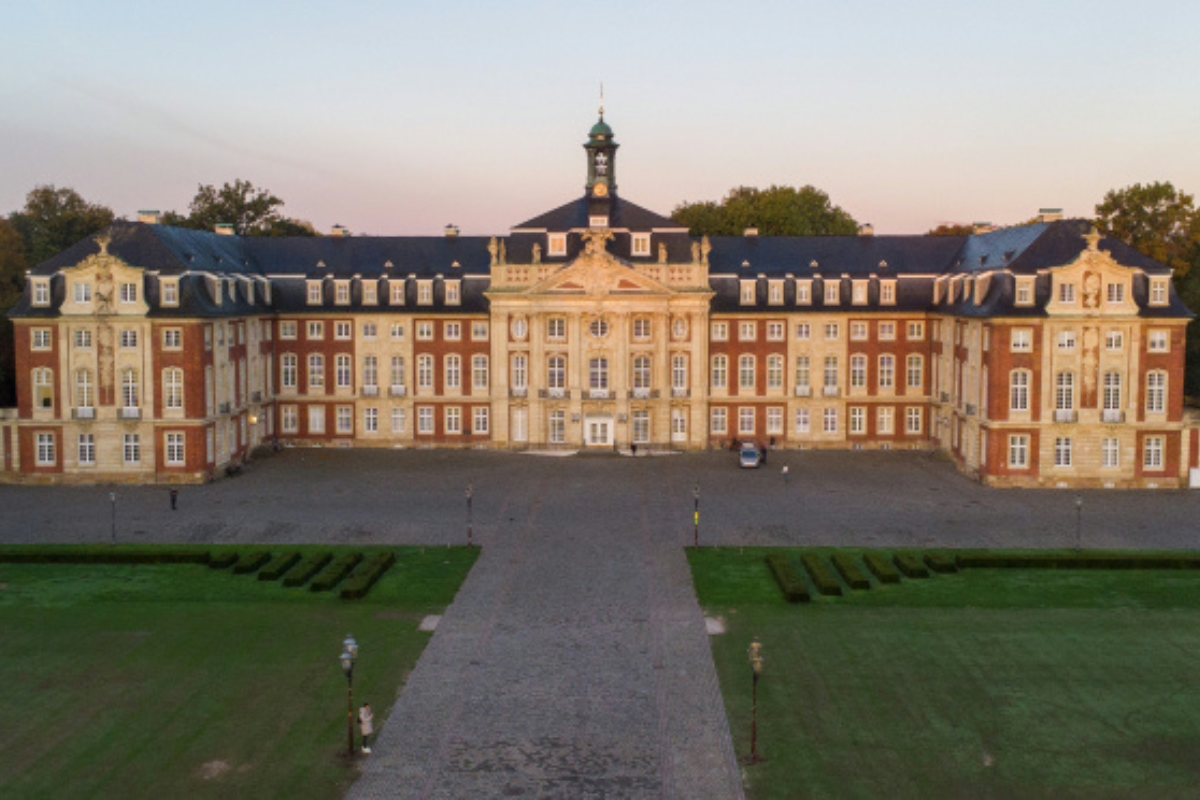
The physical mobility phase of the Blended Intensive Programme will take place at the University of Münster from 14 to 18 September 2026. During this on -site week, participants will engage in intensive collaborative learning, interactive workshops, and project-based work in an international setting.

Agenda

September 14, 2026 (Monday)

  • 9:15 Arrival
  • 9:15-9:45 Welcome to Münster! Intro and organisational issues (University Münster Team)
  • 9:45-12:30 Inclusion, Exclusion, and Inequality in Innovation Systems: Analyzing structural barriers and unequal participation (in entrepreneurship) (Miriam Sebova, TUKE)
  • 12:30-2:00 Lunch break
  • 2:00-4:00 Visit REACH, focus on Diversity and Sustainability, and clarify terminology of learning spaces, such as safer and braver spaces (Lea Kipper & Greta Böske, UM)
  • 6:00 Opportunity for a group dinner in the center of Münster (Optional)

September 15, 2026 (Tuesday)

  • 9:00-12:00 Understanding entrepreneurship as an embedded socio-economic and cultural practice. Investigating inequalities in funding, support structures, and entrepreneurial infrastructures. (Desiree Wieser, MCI)
  • 12:00-1:30 Lunch break
  • 1:30-4:30 Empowerment Session I (Namrata Sethi, HH)
  • 6:00 Guided City Tour (Optional)

September 16, 2026 (Wednesday)

  • 9:30-12:30 Translating social and environmental challenges into entrepreneurial opportunities (Julia Reinhard, HH)
  • 12:30-2:00 Lunch break
  • 2:00-4:00 Inclusive Innovation and Co-Creation Processes I (Julia Reinhard, HH)
  • 4:00-5:30 Business Models for Inclusive and Sustainable Value Creation: Developing models that integrate economic viability and societal impact (Lea Kipper & Greta Böske, UM)

September 17, 2026 (Thursday)

  • 9:30-12:30 Interviews with Start-Up Teams (Lea Kipper & Greta Böske, UM)
  • 12:30-2:00 Lunch break
  • 2:00-4:00 Inclusive Innovation and Co-Creation Processes II (Julia Reinhard, HH)


September 18, 2026 (Friday)

  • 9:30-12:30 Empowerment Session II (Namrata Sethi, HH)
  • 12:30-2:00 Lunch Break
  • 2:00-4:00 Sum up and Farewell

Virtual Component

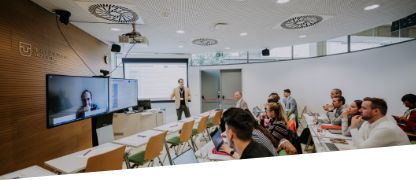
The Blended Intensive Programme consists of two virtual sessions and one on-site phase at the University of Münster. The first online session is designed to enable participants to get to know each other, clarify expectations, and receive an initial theoretical input that forms the conceptual foundation for the subsequent on-site component. The second online session takes place after the on-site week and is dedicated to the presentation and discussion of the student-developed projects, providing space for collective reflection and feedback. All three components – the preparatory virtual session, the on-site phase, and the concluding virtual session – are mandatory and must be successfully completed in order to receive a certificate of participation.

The virtual sessions will be conducted via Microsoft Teams. Access information will be provided in advance. Participants are expected to have access to an appropriate device (e.g., laptop or tablet) and to actively contribute to discussions and collaborative activities. Each online session is coordinated by a designated teaching team responsible for both academic content and technical facilitation. Required readings and materials for self-study and preparation will be made available via a shared cloud platform following the first virtual meeting.

Programme of the Online Sessions:

  • Virtual component I:
    September 7, 2026, 10am-1pm
    Getting to know each other / theoretical input
  • Virtual component II:
    October16, 2026, 10am – 2pm
    Project Presentations and final discussions

Professors

  • Desiree Wieser (MCI)
  • Greta Böske (UM)
  • Julia Reinhard (HH)
  • Lea Kipper (UM)
  • Miriam Sebova (TUKE)
  • Namrata Sethi (HH)

*Preliminary list, subject to change.

More information