


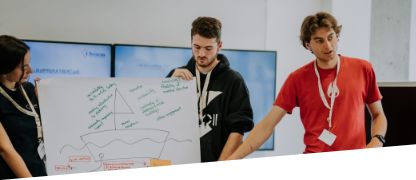


Ulysseus Winter School on Innovative Pedagogy

This Winter School 2027 in Košice invites Ulysseus teachers to collaboratively explore and apply the innovative principles outlined in the Ulysseus Pedagogical Guidelines. Through interactive learning, hands-on practice, and shared reflection, participants will gain a holistic understanding of Ulysseus pedagogy and discover practical ways to implement these principles in joint courses and degree programmes.


Please be aware that your home university may set a different application deadline depending on their internal selection process.

Registration dates 14 October 2026 23 November 2026
Course dates 08 March 2027 12 March 2027
Registration is open
Ulysseus Winter School on Innovative Pedagogy

Course Outline

This Winter School 2027 in Košice offers an intensive professional development experience grounded in the Ulysseus Pedagogical Guidelines, aimed at fostering innovative, student-centred, and future-oriented teaching practices in higher education. Through a blended format combining an online introduction and five onsite days, participants engage in interactive workshops, peer exchange, and reflective activities focused on key pedagogical cornerstones: student-centredness, competence-based and aligned course design, authentic and challenge-based learning, and the meaningful use of digital tools and AI. The program integrates theoretical inputs with hands-on design activities, international perspectives, and real-world innovation experiences, supporting participants in developing a coherent and reflective pedagogical approach aligned with the Ulysseus educational vision.

Course Content

The course addresses a set of interconnected pedagogical topics that reflect the educational vision of the Ulysseus alliance and current developments in higher
education teaching and learning. The main topics include:

  • Ulysseus Pedagogical Framework: principles and guidelines underpinning innovative, inclusive, and international higher education teaching.
  • The role of the university teacher: reflective teaching identity, teaching philosophies, and professional responsibility in international and multicultural contexts.
  • Student-centred learning: strategies for active student engagement, inclusive teaching practices, and student-centred approaches in online and international settings.
  • Competence-based education and constructive alignment: defining learning outcomes, aligning teaching activities and assessment, and applying Bloom’s taxonomy in course design.
  • Learning design processes: systematic approaches to designing coherent courses and programmes, supported by peer reflection and feedback.
  • Authentic and challenge-based learning: designing real-world learning experiences, applying design thinking, and connecting education with societal and professional challenges.
  • Digital transformation in higher education: effective use of digital tools to support teaching and learning innovation.
  • Artificial intelligence in education: pedagogically meaningful, ethical, and transparent uses of generative AI, including opportunities, risks, and academic integrity.
  • Reflective and integrative practice: synthesising pedagogical principles into a coherent personal teaching philosophy and transferable teaching strategies.

Learning Outcomes

Following this course, academic staff will be able to:

have developed both conceptual understanding and practical competencies aligned with the Ulysseus pedagogical vision. In particular, the target audience will be able to:

  • Understand and apply the Ulysseus Pedagogical Guidelines as a coherent framework for designing, delivering, and reflecting on higher education teaching in international and multicultural contexts
  • Collaborative Online International Learning (COIL) competence
  • AI-supported education and innovative pedagogy pedagogically meaningful integration of generative AI into course design, teaching, learning and assessment
  • AI-supported personalisation and feedback; development of AI literacy and critical thinking; human–AI collaboration
  • Ethical, transparent and responsible AI use in higher education

Requirements

  • English language proficiency at a minimum level of B2.
  • Priority is given to academic staff who are designing and implementing joint Ulysseus courses and programmes.

Virtual Component

Practical Details Regarding the Virtual Component:

  • Welcome and reciprocal presentation
  • Overview of Ulysseus Pedagogical Guidelines
  • Winter School’s presentation

Physical Mobility

Day 1 (Monday)

Morning

  • Opening of the Winter School
  • Ulysseus Pedagogical Framework, Interactive introductions, small groups discussions.

Afternoon

  • The role of the university teacher
  • Small group work
  • Peer discussions
  • Reflection on inclusive practices for multicultural classrooms
  • Exploring Košice City Center

Day 2 (Tuesday)

Morning

  • Student-centred learning
  • PhD. Students – Best practices, Learning outcomes

Afternoon

  • Competence-based education and constructive alignment

Day 3 (Wednesday)

Morning

  • Learning design processes, Authentic learning
  • Expert from Industry/Invited Lecture

Afternoon

  • Authentic and challenge-based learning
  • Expert from Industry/Invited Lecture

Day 4 (Thursday)

Morning

  • Authentic and challenge-based learning
  • Expert from Industry/Invited Lecture

Afternoon

  • Artificial intelligence in education: pedagogically meaningful, ethical, and transparent uses of generative AI, including opportunities, risks, and academic integrity

Day 5 (Friday)

Morning

  • Reflective and integrative practice – Synthesis workshop: Connecting the cornerstones
  • Exemplary Ulysseus courses integrating all principles
  • Reflective practice: personal pedagogical philosophy
  • Collaborative-ended reflection and future perspectives

Afternoon

  • Reflective practice: personal pedagogical philosophy
  • Collaborative-ended reflection and future perspectives

Application Process

Application submission procedure:

  1. The application, together with all attachments, must be submitted to the faculty coordinator of your partner universtity by the specified deadline. For more local information, please contact your Ulysseus Mobility Officer.
  2. Mandatory application attachments: Staff Mobility Agreement.
  3. Applications may be submitted to faculty coordinators at your partner university until 23 November 2026.

Participant selection criteria:

  • Submitted application with all attachments complete.
  • English language proficiency at a minimum level of B2.
  • Priority is given to academic staff who are designing and implementing joint Ulysseus courses and programmes.

After sucessful selection:

  1. Following the successful selection of the applicant by university management, the participant will be contacted by the Erasmus+ institutional coordinator regarding the next
    steps.
  2. The successfully selected applicants are also required to register at the registration page for the Winter School: https://events.ulysseus.eu/event/75/registrations/57/

The maximum number of desired Erasmus BIP participants (granted or zero granted) and precise if non-BIP participants, can be added (for University of Montenegro participants
who can’t be counted as BIP participants, max 3 participants).

Professors

  • Miroslav Kelemen (Technical University of Košice, Slovak Republic)
  • Marika Alhonen (Haaga-Helia University of Applied Sciences, Finland)
  • Lucia Knapčíková (Technical University of Košice, Slovak Republic)
  • Jana Pócsová (Slovak University of Technology in Bratislava, Slovak Republic)
  • Dušana Babicová (Catholic University in Ružomberok, Slovak Republic)
  • Jana Trabalíková (University of Žilina, Slovak Republic)
  • František Babič (Technical University of Košice, Slovak Republic)
  • Denisa Olekšáková (Technical University of Košice, Slovak Republic)
  • Alica Tobisová (Technical University of Košice, Slovak Republic)
  • Andrea Mojžišová (Technical University of Košice, Slovak Republic)

More information