






Open Discussion on Participatory Data Governance and Shared Digital Responsibility for a Trustworthy AI
At the centre of the Ulysseus Open Class Cooperative Models for Trustworthy AI: Participatory Data Governance for Social Value are the questions on how cooperative governance, shared data ownership and ethical approaches to AI can contribute to more trustworthy, inclusive and socially beneficial digital ecosystems.

The online Open Class brought together academics, researchers and practitioners from different disciplines and European organisations to discuss alternatives to conventional, privately controlled AI models and explore how citizens can become active participants in the governance of data and AI-mediated processes.
The session was introduced and moderated by Clio Flego, Manager of the Innovation Hub in Robotics at the University of Genoa, who highlighted the importance of approaching AI ethics and governance through an interdisciplinary perspective. She emphasised the need to connect European-level discussions with regional initiatives and encouraged an open, participatory exchange among the attendees.
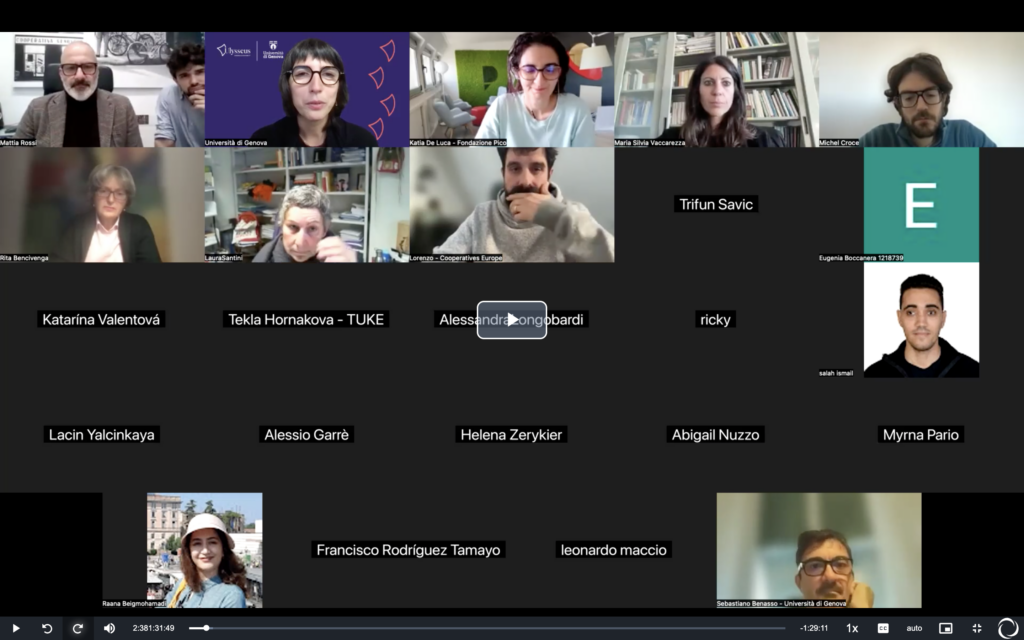
From private ownership to cooperative AI: Mattia Rossi presents a model of digital subsidiarity
Mattia Rossi, President of Legacoop Liguria, introduced the cooperative model developed through the collaboration between Legacoop Liguria, Fondazione PICO and a network of academic and institutional stakeholders, including researchers from the University of Genoa.
Starting from a fundamental question – which model of artificial intelligence do we want for citizens? – Rossi outlined the differences between privately controlled AI systems and cooperative alternatives based on shared ownership, democratic governance and collective objectives.
A central concept of his presentation was digital subsidiarity, extending the principle of subsidiarity to the digital environment. The idea is to enable citizens to organise collectively to protect and exercise their rights in an increasingly digital society, ensuring that technological infrastructures respond to shared needs rather than being driven exclusively by private interests.
Rossi presented three concrete initiatives illustrating how this approach could be implemented:
- Cooperative podcast: a proposed model of cooperative publishing in which listeners become members of the cooperative rather than passive consumers. Members would participate in defining editorial priorities and contribute to verifying the reliability and accuracy of information and sources.
- Cooperative urban data registers: a network of interconnected public data registers at urban level. Participants, including citizens and businesses, would retain ownership of their data while contributing to collectively defined objectives. Rather than centralising information in a single database, the initiative aims to facilitate cooperation between distributed registers.
- Data cooperative: an initiative designed to bring together different categories of data generated by cooperative members, including consumption-related and complementary healthcare data. The objective is to transform citizens from passive data providers into active members who can exercise control over their information and participate in decisions concerning its use. The initiative is already in an experimental phase and has been tested with a few thousand cooperative members using aggregated data.
Rossi also introduced the proposal of a new legal principle, ius dati, concerning individuals’ rights to be properly informed and to manage and control their personal data and the processes through which it is used.
Together, these initiatives aim to establish cooperative platforms as trusted intermediaries for information and data flows, offering an alternative to profit-driven algorithms and concentrated ownership.
Trustworthy AI requires collective accountability: Michel Croce’s contribution
Michel Croce, Associate Professor of Moral Philosophy at the Department of Antiquities, Philosophy and History (DAFIST), University of Genoa, explored the philosophical foundations of trust in AI and the conditions necessary to establish trustworthy digital environments.
He highlighted an important distinction between trusting human beings and trusting technological instruments. While human trust generally involves assessing sincerity and competence, trust in instruments traditionally depends on their calibration and consistency. AI systems complicate this distinction because they increasingly perform complex tasks, while their internal processes remain difficult to understand and monitor.
Croce argued that promoting AI literacy and teaching individuals to identify misinformation are not sufficient responses. Instead, it is necessary to transform the information environment itself, making collective verification and accountability possible.
He identified five essential capabilities that should be guaranteed within trustworthy digital environments:
- Provenance: citizens should be able to identify where information originates and which sources support it.
- Contestability: individuals should be able to challenge information, with their objections and the related processes remaining accessible and traceable.
- Correctability: corrections should be visible rather than silently replacing previously available information.
- Traceability: users should be able to understand the evidence, assumptions and value judgements behind the information they receive.
- Visibility of dissent and uncertainty: disagreements and unresolved questions should remain visible instead of being concealed behind apparently definitive answers.
His contribution emphasised that trustworthiness should not be understood as blind confidence in a technological system. It should instead emerge from the capacity of citizens to monitor, question and collectively influence the systems they use.
Beyond principles: Maria Silvia Vaccarezza on artificial practical wisdom
Building on Croce’s contribution, Maria Silvia Vaccarezza, Associate Professor of Moral Philosophy at DAFIST, University of Genoa, proposed a broader philosophical framework for AI ethics.
She questioned the limitations of conventional principle-based approaches, which frequently rely on lists of values such as transparency, fairness and safety. While important, these principles may be insufficient to address the increasingly complex situations involving AI systems and their growing capacities for autonomous action.
Vaccarezza suggested moving towards a context-based, virtue-oriented approach, drawing on philosophical traditions, particularly Aristotelian ethics.
She introduced the concept of artificial practical wisdom: a form of general ethical competence that would enable AI systems to address complex moral situations by considering different values and balancing potentially conflicting considerations.
An important aspect of this approach is epistemic justice: the capacity to recognise underrepresented experiences, identify whose voices are missing and avoid reproducing inequalities in the construction and circulation of knowledge.
Rather than treating ethical values as separate modules, Vaccarezza argued for developing a more comprehensive capacity for moral sensitivity, deliberation and the evaluation of competing reasons.
She clarified that this work is currently at a theoretical development stage, with a related academic paper under review, and that further research is needed to explore its practical implementation.
Inclusion, representation and accessibility: Sebastiano Benasso’s perspective
Sebastiano Benasso, Associate Professor of Sociology and Vice Director of DISFOR at the University of Genoa, and Coordinator of Equality, Diversity and Inclusion and Community Engagement at Ulysseus European University, brought the discussion towards the social implications of AI governance.
Drawing on a question initially raised by his colleague Rita Bencivenga, Benasso asked how diversity and inclusion are incorporated into cooperative AI models.
He particularly highlighted the risk that marginalised groups, which are often less visible in public discourse and underrepresented in datasets, may be described through stereotypes rather than represented through their actual experiences, perspectives and needs.
He also raised the issue of linguistic accessibility, questioning whether AI-generated knowledge and the languages prioritised by AI systems are genuinely accessible to people whose languages are not represented in mainstream digital environments.
His intervention stressed that participatory governance must address not only who owns and controls data, but also whose experiences are represented, whose voices are heard and who can access the knowledge generated through AI.
Ethical supervision and practical experimentation: Tekla Horňáková’s contribution
Tekla Horňáková, Senior Researcher on Circular Economy, Public Health and AI at the Technical University of Košice (TUKE), contributed to the discussion from both a theoretical and an applied perspective.
Responding to Vaccarezza’s proposal on artificial practical wisdom, she raised an important question concerning the organisation of AI agents: should ethical competences be incorporated into every individual agent, or should a dedicated supervisory agent oversee the actions of other agents and intervene when necessary?
This contribution opened a discussion on how ethical supervision could be translated into the architecture and governance of multi-agent AI systems.
Horňáková also presented a possible experimental approach connected to circular economy and participatory decision-making. Her team is exploring how AI-supported information environments could influence decisions concerning the installation of shared solar panels in residential buildings.
The proposed study would compare two approaches: conventional information sharing through documents and leaflets, and an AI-supported assistant providing document-based information.
The latter would make sources visible, distinguish facts from estimates, communicate levels of certainty, preserve correction histories and allow participants to ask questions.
The objective is to investigate how different ways of presenting and evaluating information influence collective judgement and decision-making processes, particularly in the implementation of circular economy initiatives.
Language, communication and ethical behaviour: Laura Santini’s reflection
Laura Santini contributed by raising questions about the practical development and accessibility of the initiatives presented, asking whether pilot projects, online platforms or publicly accessible examples were already available.
In her concluding remarks, she highlighted the potential contribution of linguistics, pragmatics and discourse analysis to understanding ethical behaviour and communication.
She emphasised that human actions, including moral and immoral behaviours, are expressed through both verbal and non-verbal language and are shaped by their contexts. From this perspective, discourse analysis can help reveal whose voices are represented, who is given the opportunity to speak and whose perspectives remain marginalised.
Her reflection complemented the discussion on inclusion and representation, connecting ethical AI development with the broader social and communicative conditions through which knowledge is produced and shared.
Towards a more inclusive and trustworthy AI ecosystem
The Open Class demonstrated the importance of connecting technological innovation with cooperative governance, philosophical reflection and social inclusion.
The contributions highlighted several challenges that remain open for further investigation: how to validate cooperative models in practice, how to ensure that marginalised communities are adequately represented, how to make AI-generated knowledge accessible across different languages and contexts, and how to implement effective ethical supervision in increasingly complex AI systems.
By bringing together perspectives from engineering, philosophy, sociology, linguistics and circular economy, the initiative contributed to the broader Ulysseus discussion on responsible technological innovation and the social value of research.
The exchange also reinforced a central question for the future of AI: how can citizens move beyond being passive users and data providers to become active participants in defining, governing and benefiting from the digital systems that increasingly shape society?
Through its Innovation Hub in Robotics, the University of Genoa will continue fostering interdisciplinary dialogue and collaboration around trustworthy AI, cooperative models and human-centred technological development.
About Ulysseus
Ulysseus is one of the 64 European Universities selected by the European Commission to become the universities of the future. Led by the University of Seville, the Alliance encompasses other seven universities in Europe: the University of Genoa, Italy; Université Côte d’Azur, France; the Technical University of Košice, Slovakia; MCI | The Entrepreneurial School®, Austria; Haaga-Helia University of Applied Sciences, Finland, the University of Münster, Germany, and the University of Montenegro, Montenegro.