




Ulysseus Alliance Strengthens International Network of University Partnerships in Brussels
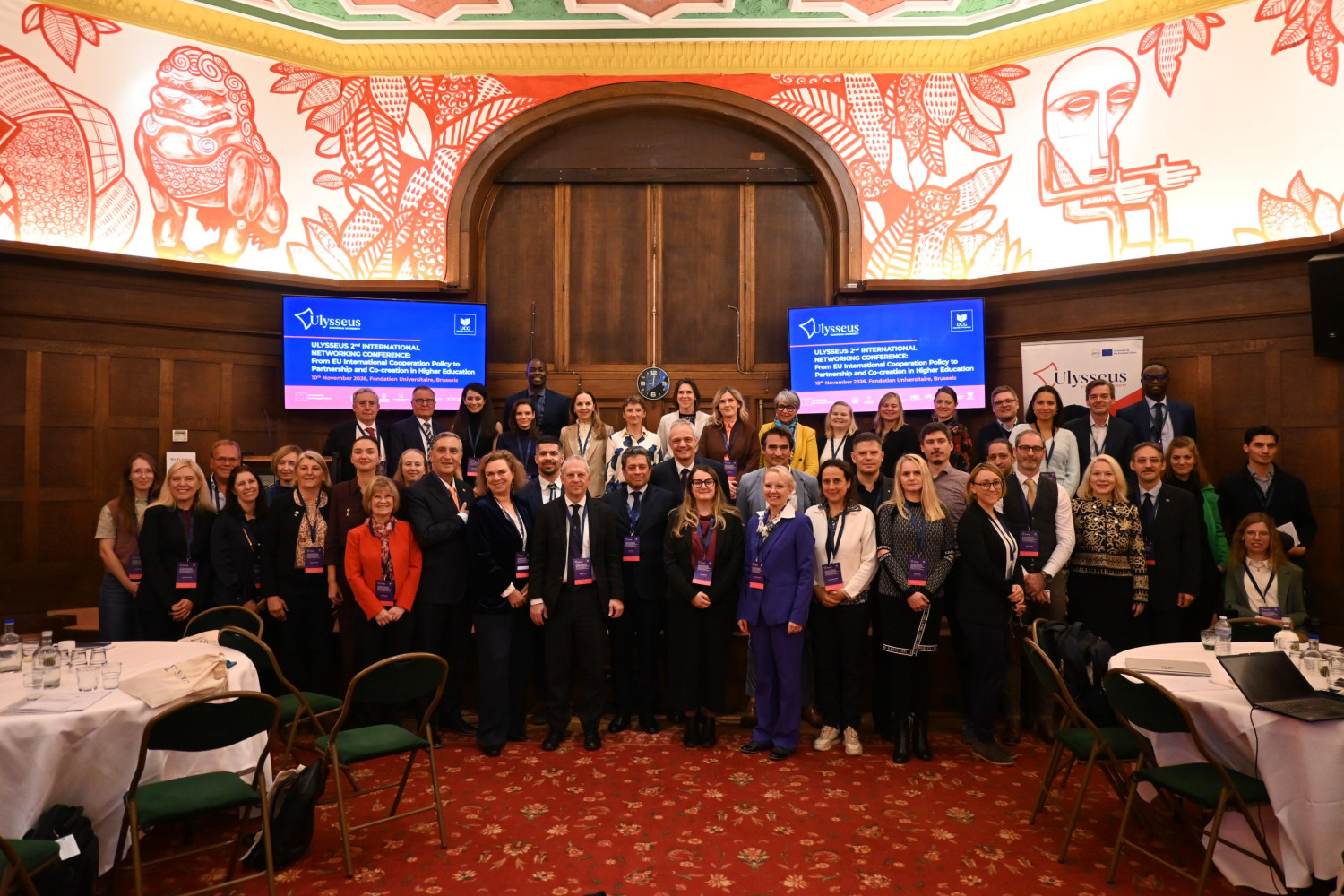
Strengthening international university partnerships and exploring new directions for cooperation with institutions beyond the European Union were at the heart of the second international conference of the Ulysseus Alliance, held in Brussels. Coordinated by the University of Montenegro (UoM), the conference brought together representatives of European institutions and universities from different parts of the world.
One of the key objectives of the conference was to further develop the Ulysseus International Cooperation Network by establishing connections with universities from Canada, Latin America and Africa. The next steps towards formalising partnerships through Letters of Intent were also discussed, with the aim of developing joint educational programmes and research projects.
The conference, entitled “From EU International Cooperation Policy to Partnership and Co-creation in Higher Education”, also addressed the future of international cooperation in the context of the Global Gateway strategy, the European Union’s post-2027 financial framework and the development of European University Alliances.
At the opening of the conference, participants were welcomed by Prof. Rocío Martínez de Pablos, Ulysseus Coordinator; Ms Joana Devandeler from the European Commission; and Mr Petar Marković, Head of the Mission of Montenegro to the European Union. The conference was particularly significant as it was coordinated by the University of Montenegro, an institution from an EU candidate country that is already actively contributing, on an equal footing, to the development of European university cooperation through its membership in Ulysseus.
A panel moderated by Prof. Sanja Peković, Vice-Rector for Internationalisation at the University of Montenegro, explored how international university partnerships can contribute not only to the development of local communities but also to the transformation of universities themselves. The discussion brought together representatives of the European Commission, the University of Buenos Aires, the University of Ghana and the University of Genoa. Particular emphasis was placed on the need to move beyond traditional knowledge-transfer models towards equal partnerships based on two-way learning, jointly defined priorities and an understanding of different institutional and societal contexts.
“International cooperation is often measured by the number of projects, mobilities and signed agreements. However, a university can become more internationally active without undergoing any fundamental change. The real question, therefore, is not how to cooperate more, but how to cooperate in ways that transform our institutions, our practices and our ways of thinking. Genuine partnership requires a willingness to learn from one another, but also to question our own assumptions. Cooperation that does not change us remains merely an activity rather than a transformation,” emphasised Prof. Sanja Peković.
She also highlighted the limitations of the “one-size-fits-all” approach, in which the same models, priorities and success indicators are applied to universities operating in very different social and institutional circumstances. She stressed that co-creation does not mean involving partners only after solutions have already been developed, but rather ensuring their equal participation from the very beginning in defining problems, priorities and approaches to cooperation.
A particularly thought-provoking contribution came from Prof. Emanuel Avuni Kolog from Ghana, who highlighted shortcomings in the research system, where academic work is primarily driven by expected publication outcomes and the speed at which they can be achieved. He stressed that genuine co-creation of solutions must begin with the joint identification and understanding of challenges (co-discovery), with local communities directly involved in defining research and development priorities. This would also ensure that the realities and living contexts of African and other regions are much better reflected in research projects.
Prof. Mauricio Lambertucci from the University of Buenos Aires shared the experiences of Latin American universities in working directly with local communities, emphasising that European institutions also have much to learn from these approaches to education, research and community engagement.
Luiza Bunescu from the European Commission spoke about how the Global Gateway strategy supports skills development in partner regions. Alongside major investment projects in less developed regions, there has been an increasing focus on investing in education and science to enhance people’s knowledge and skills. Extending these efforts to public institutions and local communities is an integral part of these projects. The discussion also highlighted the need to move beyond a fragmented, project-based approach involving smaller individual projects, and the potential for Erasmus+ to serve as initial funding for much larger and more ambitious initiatives.
Prof. Luis Ramon Vacaro from the University of Genoa highlighted the importance of the Ulysseus Alliance in strengthening international partnerships, as well as the role of Innovation Hubs as centres for fostering such cooperation. He also pointed to the need to simplify administrative procedures at the local level.
The practical value of international partnerships was demonstrated through projects presented during the conference in poster and oral presentation sessions. The University of Montenegro showcased the collaboration between its Faculty of Economics and Boston College. All poster presentations are available here.
A significant part of the programme was dedicated to science diplomacy and its role in connecting academia, diplomatic institutions and policymakers. Keynote speeches were delivered by Professor Emeritus Luk Van Langenhove from Vrije Universiteit Brussel and Karel Hegeman from the European Commission’s Joint Research Centre.
A panel discussion on shared agendas between universities and diplomacy brought together representatives of universities from France, Chile and Canada. It was moderated by Ms Elke Dall, Coordinator of the Horizon Europe project CSUP – Consolidating European Science Diplomacy.
The discussion highlighted the need to strengthen students’ knowledge and skills in science diplomacy and political literacy, both of which are increasingly under pressure in today’s world. Participants also emphasised the importance of safeguarding universities’ resilience to political influence, as tensions frequently arise between academic freedom and demands for political and economic alignment.
Particular attention was given to the position of Latin American universities, which have developed a distinctive culture of resilience through challenging historical periods and have made tangible contributions to the development of their countries. This perspective was especially inspiring in the contribution by Prof. Ennio Vivaldi from Chile.
During the closing part of the conference, representatives of the Ulysseus Alliance, international partner universities and European institutions took part in interactive workshops to discuss priorities for future cooperation within the Ulysseus International Cooperation Network, as well as opportunities to enhance the Erasmus+ programme and develop more sustainable funding models.
One of the key conclusions was the importance of embedding cooperation and the values explored throughout the conference – community engagement, science diplomacy and cosmopolitanism – into the educational process itself. COIL (Collaborative Online International Learning) was highlighted as an excellent model for enhancing teaching and learning in this respect, requiring virtually no additional resources.
International partners represented at the conference included Université Laval (Canada), the University of Chile, the National Autonomous University of Mexico (UNAM), the University of Buenos Aires and the University of Ghana, with whom further cooperation is being explored through the Ulysseus International Cooperation Network.
At the invitation of the University of Montenegro, the Inter-University Centre Dubrovnik (IUC), of which UoM is a member, was also presented as a guest institution. For 50 years, the IUC has been fostering global academic cooperation, with a strong commitment to promoting and safeguarding academic freedom.
The directions for cooperation explored during the conference provide a foundation for the next phase of the Ulysseus Alliance’s development and for strengthening partnerships with institutions beyond the European Union. For the University of Montenegro, this network opens up opportunities for new research projects, educational initiatives and international mobility, while also creating space for the exchange of experience with universities operating in different social and institutional contexts. Such cooperation goes beyond the transfer of knowledge: it is about mutual learning, rethinking established approaches and developing solutions that can have a lasting impact on universities and the communities they serve.
The University of Montenegro team responsible for organising the conference included Branka Žižić, Ana Dragutinović, Sanja Peković, Ana Zdravković, Lejla Jusić and Filip Petrović, with the support of Ivana Živković, Nikola Pavlović and Vesna Vukadinović.