




Registration is now open for NEEMA Online Training on Food and Nutrition Resilience
The registration campaign for the NEEMA Online Modules is officially open! Developed by seven universities from Africa and Europe, this innovative 100% online training program aims to compile and promote best practices in food and nutrition resilience through seven complementary thematic modules.
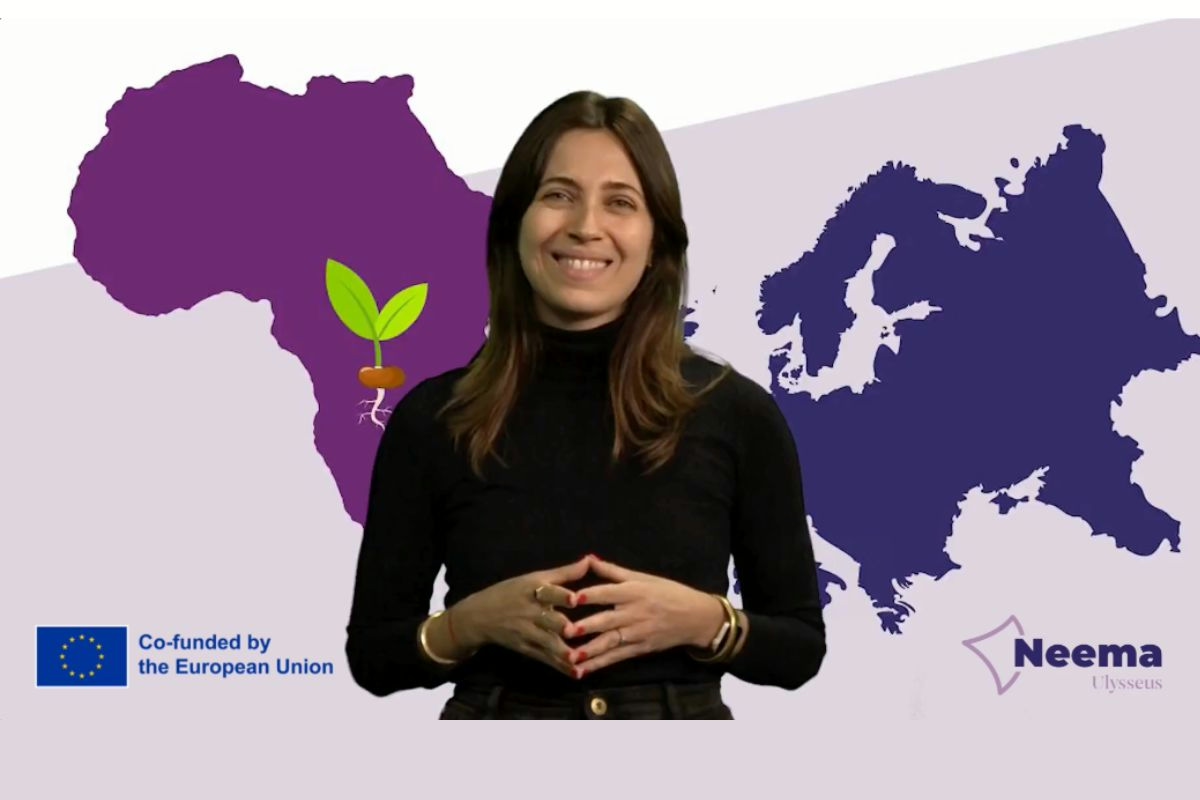
Freely accessible and delivered in French, the program is designed for students, lecturers, researchers, local and institutional stakeholders, and professionals committed to the sustainable transformation of food systems.
NEEMA Training: Empowering Change-Makers in Food and Nutrition Resilience
The NEEMA online training targets students, lecturers, researchers, policymakers and other stakeholders involved in food and nutrition resilience in West Africa. It aims to:
- Strengthen the capacities of actors in the food and nutrition sector
- Promote an interdisciplinary, inclusive and action-oriented approach
- Facilitate the transfer and adaptation of European and international best practices to African contexts, particularly in West Africa and the Sahel
- Actively contribute to the sustainable transformation of food systems
Co-developed by higher education institutions and experts from Africa and the European Union, the program is built on strong international academic cooperation and the co-construction of knowledge.
A Learning Experience Rooted in Action and Local Contexts
The NEEMA training is based on a dynamic and innovative pedagogical approach, combining solid theoretical input, contextualized case studies, practical activities and progressive assessments. Structured as a coherent sequence of modules, the program enables gradual and consistent learning, fostering the progressive acquisition of skills.
The training also promotes reflexivity, critical thinking and learning by doing, allowing participants to connect academic content with field realities. Module 7, dedicated to the development of local action projects, represents the practical culmination of the program, offering participants the opportunity to apply their knowledge in real and concrete contexts.
Finally, the program strongly values the co-construction of knowledge between European and African institutions.
Validation of Learning Outcomes
Each NEEMA module represents a total workload of 20 learning hours. At the end of each module, participants are required to complete an assessment designed to evaluate the knowledge and skills acquired.
Successful completion of the assessment will lead to the issuance of a certificate of achievement from the European University Alliance Ulysseus, a member of the NEEMA consortium, as well as a certificate issued by the participant’s affiliated university. This ensures double academic and institutional recognition of the completed training.
Focus on the 7 Training Modules
Each module is developed by a partner university recognized for its expertise:
- Module 1: Rural Entrepreneurship and Local Capacities for Food and Nutrition Resilience – Developed by Management Center Innsbruck (Austria)
- Module 2: Social Innovation for Rural Development and Sustainable Food Systems – Developed by Amadou Mahtar Mbow University (Senegal)
- Module 3: Strengthening Agricultural Value Chains of Smallholder Producers – Developed by Cheikh Anta Diop University (Senegal)
- Module 4: Sustainable Development Goals and Food and Nutrition Resilience: A Holistic Approach to SDG 2 and Its Interlinkages with Other SDGs – Developed by the University of Seville (Spain)
- Module 5: Gender Equality: Achieving Equality and Empowering All Women and Girls – Developed by Haaga-Helia University of Applied Sciences (Finland)
- Module 6: Sustainable Practices in Agri-Food Waste Valorisation: From Extraction Technologies to Applications – Developed by the University of Genoa (Italy)
- Module 7: Development of Local Action Projects (Practical Module) – Developed by the Rural Polytechnic Institute for Training and Applied Research of Katibougou (Mali)
Key Dates and Information
- Registration period: 2 March – 25 March 2026
- Training starts: Wednesday, 1 April 2026
- Language: French
- Format: 100% online
- Access: Free of charge
- Registration: Mandatory
Registrations are open until 25 March 2026. Register now and become a driver of change! Follow our YouTube page for more content