






Not All Experts Are Equal: Helping Students Evaluate Authority in the Age of AI
This publication is written by Tamara N. Lewis Arredondo, Instructional Designer at The Hague Center for Teaching and Learning and researcher with the Multilevel Regulation research group at The Hague University of Applied Sciences, as part of the Ulysseus project METACOG.
Imagine one of your students is researching the effectiveness of a public health intervention for a policy brief assignment. She uses a generative AI tool to get an overview of the evidence. The AI provides a confident summary, referencing “multiple studies” and “leading health experts” without naming any of them.
corroboration. She finds a report from an organization called the National Institute for Public Health Excellence. The name sounds authoritative. The website is polished. The report confirms what the AI said. Satisfied, she cites it and moves on.
But the organization is not a government body or research institution. It is an advocacy group funded by industry stakeholders with a direct interest in the policy outcome. The report is not peer-reviewed research but a position paper. Your student verified the information—and was still misled.
How would you help her recognize what went wrong?
Connecting the Threads: Triangulation, Independence, and Now Authority
In my previous articles for METACOG, I argued that lecturers should teach triangulation as a default habit—training students to verify AI-generated information through multiple sources—and that students must learn to assess whether those sources are truly independent rather than from a single origin. The Keus.nl case, in which an AI-generated voting aid produced significant errors during Dutch municipal elections, illustrated why these skills matter.
But triangulation and independence are not enough. Your students can consult multiple sources, confirm that they are genuinely independent, and still be misled if those sources lack appropriate authority for the claim in question. If triangulation is the what and independence is the how of verification structure, authority is the how of source evaluation. Together, they form a complete framework you can use to guide students through the challenge of navigating AI-generated information.
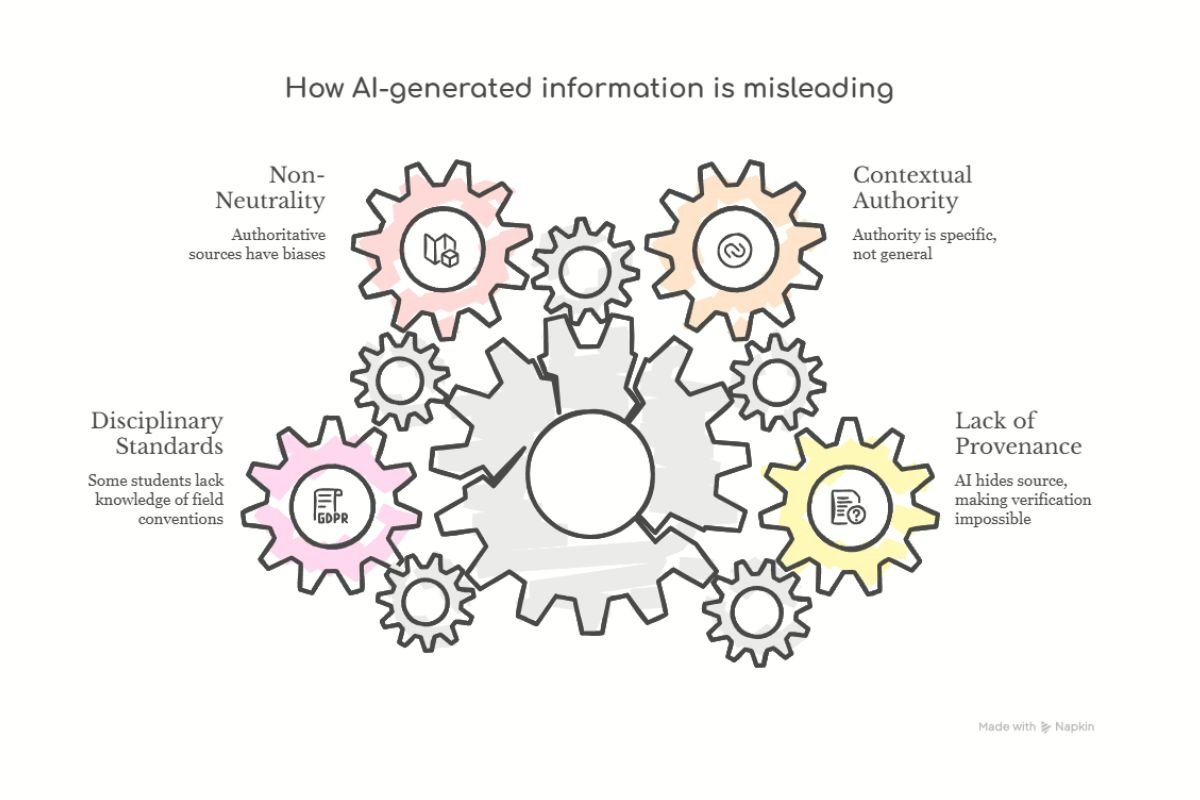
Lesson One: Teach Students to Demand Provenance First
Your student’s first problem occurred before she ever evaluated authority: the AI gave her information without telling her where it came from. She could not assess the credibility of unnamed “studies” and unidentified “experts.” The authority had been stripped away, leaving only the claim.
This is a fundamental challenge with generative AI. These systems synthesize information from vast corpora but rarely surface their sources. Students receive confident outputs with no way to trace them back to their origins. Verification becomes guesswork.
As a lecturer, you can address this by teaching students to demand provenance before anything else. When AI provides a claim, the immediate question should be: Where does this come from? Train your students to prompt the AI for specific sources—and to verify that those sources actually exist. If the AI cannot provide them, or if the sources it names turn out to be fabricated, students know to treat the information with skepticism.
You might build this into your assignments explicitly. Ask students to document not just the sources they used but the process by which they obtained them. Did the AI provide the source, or did the student locate it independently? This small requirement makes provenance visible and accountable.
Lesson Two: Help Students Ask “Authoritative for What?”
Once provenance is established, students face a second challenge: a source can be authoritative on one matter but not another. Authority is not a general property. It is specific to the substance of the claim being made.
Consider your student’s scenario. A government health agency might be highly authoritative on approved treatment protocols but less authoritative on emerging research that has not yet been incorporated into official guidelines. A patient advocacy organization might offer valuable insight into lived experience but limited expertise on clinical trial methodology. A pharmaceutical company’s internal research might be scientifically rigorous but shaped by commercial interests.
You can help students navigate this by teaching them to ask: Authoritative for what kind of claim? In class discussions or assignment guidelines, prompt students to match the source’s expertise and institutional role to the specific nature of the question they are investigating. A source that is credible for policy recommendations may not be credible for epidemiological data. A source that is credible for historical context may not be credible for current statistics.
Create exercises where students evaluate the same source for different types of claims. This helps them see that authority is contextual—and that AI outputs, which collapse all claims into the same confident register, erase the nuances that careful researchers must restore.
Lesson Three: Show Students That Authority Is Not Neutrality
Even genuinely authoritative sources are not neutral. They have perspectives, funding structures, and institutional missions that shape how they present information. This does not mean they are unreliable—but it does mean that students must read them critically.
This lesson connects directly to the previous essay on source independence, which emphasized the importance of asking who funded or produced the original research. As a lecturer, you can reinforce this connection by helping students understand that the same questions apply when evaluating authority. An authoritative source with a declared interest in a particular outcome is still authoritative, but its conclusions carry different weight than those of a source with no such interest.
Your student’s mistake was assuming that an official-sounding name guaranteed neutrality. She did not ask who funded the organization, what its institutional mission was, or whether it had a stake in the policy debate. You can prevent similar mistakes by teaching students to investigate the “About” pages of organizations they cite, to search for funding disclosures, and to consider what institutional incentives might shape the source’s presentation of evidence.
Make clear that this is not about disqualifying sources with known interests. Authoritative sources with perspectives can be cited for their arguments, their data, or their interpretation—but students should be explicit about the source’s position rather than treating it as disinterested truth. Teach them to write sentences like “According to [Organization], which advocates for [position]…” rather than presenting interested sources as neutral actors.
Lesson Four: Make Disciplinary Standards Explicit
What counts as authoritative varies across fields, and your students may not yet know the conventions of the discipline you are teaching. A first-year nursing student may not recognize the difference between a peer-reviewed clinical trial and a policy white paper. A political science student may not know which think tanks are considered credible across the ideological spectrum. An engineering student may not understand the hierarchy of technical standards bodies.
This is where your expertise becomes indispensable. AI tools do not teach disciplinary conventions. They present information from all sources in the same tone and format, offering no guidance on which voices carry weight within a given field. You, as the educator and discipline expert, must make these conventions explicit.
Dedicate class time to discussing what counts as a primary source in your discipline, which institutions are considered credible, and what markers indicate peer review, editorial oversight, or methodological rigor. Provide students with annotated examples of strong and weak sources. Create reference guides they can consult when evaluating unfamiliar sources.
These conversations cannot be left to generic information literacy workshops. They must happen within your classroom, embedded in the contexts where students will actually apply them.
A Framework You Can Teach
Taken together, these four lessons form a practical sequence you can share with your students:
- First, demand provenance. If the source of a claim cannot be identified, suspend judgment until it can.
- Second, ask whether the source is authoritative for the specific type of claim being made. Match the expertise to the question.
- Third, consider the source’s institutional position. Authority does not mean neutrality. Understand the perspective and factor it into your interpretation.
- Fourth, apply discipline-specific standards. Learn what counts as credible in your field and hold sources to those criteria.
You might present this framework as a checklist, a classroom poster, or a required component of research assignments. The format matters less than the consistency: students internalize habits through repeated practice, not single exposure.
Generative AI has made information abundant and accessible. It has also made evaluation harder. When claims arrive without provenance, when sources are stripped of context, and when confident prose masks uncertain foundations, your students need guidance that the technology cannot provide.
Triangulation, independence, and authority are not separate skills. They are layers of a single practice: the careful, critical work of determining what to believe. When you teach these skills, you are not merely preparing students for academic success. You are cultivating the epistemic judgment that informed citizenship requires.
As I noted in the first essay of this series, AI does not know. It predicts, synthesizes, and approximates. The same is true of authoritative sources: they inform, but they do not remove the need for judgment. Teaching students to evaluate authority is teaching them that no source—however credible—relieves them of the responsibility to think. And guiding them through that process is among the most important work you can do.