






Who Is Feeding Your Chatbot? What AI Assistants Read Before They Answer

This publication is written by Aleksandar Plamenac, Teaching assistant, University of Montenegro, as part of the Ulysseus project METACOG.
In May 2024, Google started showing AI-generated summaries, called AI Overviews, at the top of its search results. Within days, screenshots of its stranger answers were everywhere. Asked how to stop cheese from sliding off pizza, it suggested adding glue to the sauce. Asked how many rocks a person should eat, it recommended a few small ones a day. Neither idea came from the AI itself. The glue tip traced back to an 11-year-old joke on Reddit, and the rocks came from a satirical article.
The answers were funny. The lesson behind them is serious: a chatbot’s answer can only be as good as what it read before answering.
Your Chatbot Reads So You Don’t Have To
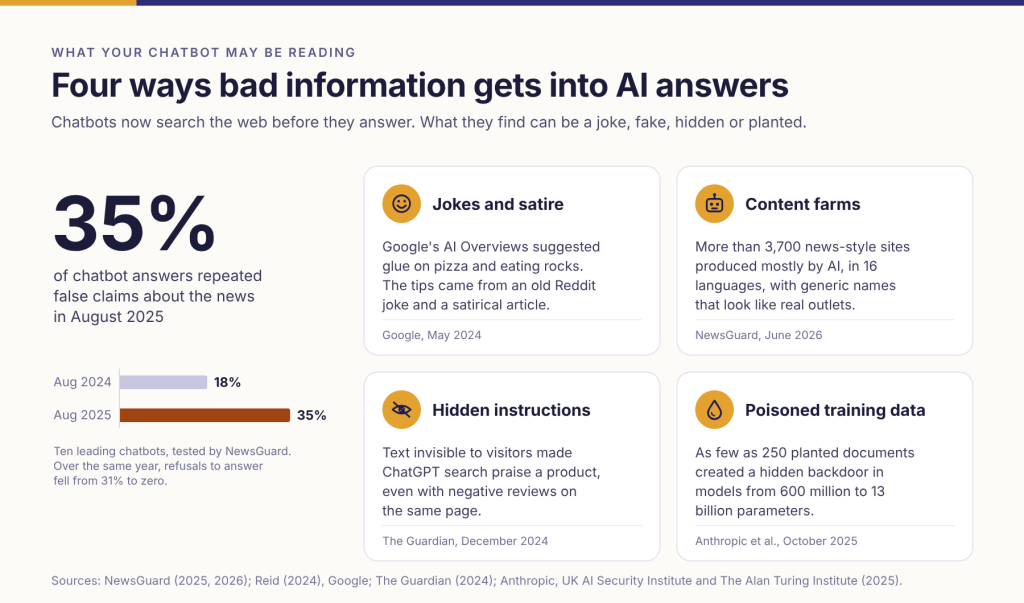
Most popular AI assistants now search the web before they reply. That keeps their answers current, but it also ties their reliability to whatever pages they happen to find. In August 2025, the media watchdog NewsGuard found that the ten leading chatbots repeated false claims about news topics 35% of the time, almost double the 18% of a year earlier. Over the same period, the share of questions they declined to answer fell from 31% to zero (NewsGuard, 2025). Chatbots have become eager to answer everything, and that eagerness makes them easier to feed.
Four Ways the Feed Goes Wrong
Jokes and satire taken as fact. Google later explained that almost nobody had searched for how many rocks to eat before the screenshots went viral. With so little serious content on the question, the system leaned on a satirical piece that a geology software company had republished on its website. Google called this a “data void” (Reid, 2024). Researchers use the same term for topics where reliable information is scarce, which leaves the field open to whatever happens to be online (Golebiewski & boyd, 2019).
Content farms. Generative AI has made it cheap to run websites that look like news outlets but are produced almost entirely by machines, with little or no human oversight. As of June 2026, NewsGuard had identified more than 3,700 of these “AI content farm” sites in 16 languages, usually with generic names that sound like ordinary news or business outlets (NewsGuard, 2026). To a chatbot searching the web, they can look like any other source.
Hidden instructions. Web pages can contain text that human visitors never see. In December 2024, The Guardian tested ChatGPT’s search feature on pages it had built itself. Hidden text was enough to make the chatbot describe a product in entirely positive terms, even when the same page carried negative reviews (The Guardian, 2024). The technique, known as prompt injection, turns an ordinary web page into instructions for the AI that reads it.
Poisoned training data. Some manipulation happens long before anyone types a question. In 2025, researchers from Anthropic, the UK AI Security Institute and The Alan Turing Institute showed that as few as 250 malicious documents could plant a hidden “backdoor” in language models of every size they tested, from 600 million to 13 billion parameters. Their backdoor was deliberately low-stakes: a trigger phrase that made the model produce gibberish, and the authors note it is unclear whether more harmful behaviors work the same way. Still, the result challenges a comforting assumption, namely that a few bad documents simply get lost among billions of good ones (Anthropic, 2025).
The Echo, Industrialized
Earlier in this series, Tamara Lewis Arredondo showed how a claim repeated across many outlets can look independently confirmed while tracing back to a single origin, and how AI tools inherit that echo.
In her example, the echo happened by accident. Content farms turn it into a business model: the same claim, rewritten across dozens of sites, all from one source.
Chatbots then add a second layer. You never see the pages they read. You see one fluent, confident paragraph, and the quality of its sources disappears into the prose. The claim is laundered twice: once through many websites, and once through the chatbot’s summary.
What Readers Can Do
A few habits go a long way:
- Open the sources. If a chatbot cites links, click them. An unfamiliar site with a generic news nam deserves a look at its “About” page and its ownership.
- Check how old and how busy a site is. A domain lookup shows when a site was registered. A “news” site that appeared recently, publishes dozens of articles a day and names no authors is a warning sign.
- Ask whether it could be a joke. Strange advice often traces back to a forum thread or a satire site. Find where a claim started before you repeat it.
- Slow down on new and niche questions. That is where data voids are largest and false claims travel fastest.
- Push back on the answer. Ask the chatbot which reliable outlets confirm the claim, or ask it for the strongest evidence against its own answer.
- Check established fact-checkers for contested claims. In Montenegro, Raskrikavanje.me regularly debunks claims that circulate in the region.
Who Reads for Us
For a long time, the key question of media literacy was whether we can trust what we read. Now there is a second question: can we trust what our tools have read on our behalf?
Chatbots are useful, but they are not neutral windows onto the world. They reflect whatever the web is filled with. AI literacy means remembering that a fluent answer can rest on a joke, a content farm or a page written to manipulate the machine reading it.
Sources consulted for this article:
- Anthropic (2025), A small number of samples can poison LLMs of any size
- Golebiewski & boyd (2019), Data voids: Where missing data can easily be exploited, Data & Society
- NewsGuard (2025), AI False Claims Monitor: August 2025
- NewsGuard (2026), Tracking AI-enabled misinformation: AI content farm news sites
- Reid (2024), AI Overviews: About last week, Google
- The Guardian (2024), ChatGPT search tool vulnerable to manipulation and deception, tests show
About METACOG
METACOG is an EU-funded AI literacy programme designed to combat disinformation and fake news by promoting civic engagement and shared European values.
The initiative aims to strengthen citizens’ ability—particularly among higher education students and teachers— to recognize and respond to disinformation through an innovative curriculum, AI-based tools, and best practices.
By acknowledging the dual role of artificial intelligence in both generating and countering disinformation, METACOG seeks to empower individuals with the critical thinking and digital literacy skills essential for navigating today’s information landscape.
Targeting higher education institutions, government and non-governmental organizations, media professionals, and the general public, METACOG is led by Haaga-Helia University of Applied Sciences (Finland) in collaboration with the Technical University of Košice (Slovakia), the University of Montenegro (Montenegro), and The Hague University of Applied Sciences (The Netherlands). The project is funded under the Erasmus+ Programme (KA220-HED) and will run from 1 September 2024 to 31 August 2027.