






Ulysseus Open Class on Protecting Minors Online Held in Podgorica
Organized by the Ulysseus Innovation Hub for Cybersecurity at the University of Montenegro, an Open Class and expert round table entitled “Protection of Minors in the Digital Environment” was held on February 27 at the Science and Technology Park of Montenegro. The event was realized within the framework of strategic academic cooperation between the University of Montenegro and the University of Genoa, as part of the European University Alliance Ulysseus. This gave the discussion a strong comparative value and a clear European perspective, based on knowledge exchange and alignment with contemporary regulatory standards.

The round table gathered representatives of the legislative and executive branches, including members of the national Parliament, regulatory and supervisory bodies, the security sector, the Institution of the Protector of Human Rights and Freedoms, international organizations, academia, the technology industry, telecommunications companies, educational institutions, and civil society organizations—recognized leaders in this field in Montenegrin society.
Such broad institutional representation confirmed that the protection of minors in the digital space is a matter of strategic public interest, requiring a coordinated and responsible approach by all relevant actors. Given that the goal of the gathering was to identify open normative issues and formulate concrete amendment proposals for the current Montenegrin draft law through expert debate, the discussion was directed toward improving the text of the law and strengthening its institutional applicability.

In the opening part of the event, Prof. Dr. Savo Tomović, Academic Director of the Ulysseus Innovation Hub for Cybersecurity, emphasized the strategic role of the University of Montenegro within the European University Alliance, stating: “It is particularly significant that the Cybersecurity Innovation Hub is located at our university. This gives us the capacity to be a regional center of knowledge and initiatives in the field of digital security, including topics that go beyond the academic framework and are of interest to the entire community.”
The initiator of the draft law, MP Slađana Kaluđerović, stressed that the law represents a response to the profound social changes that the digital environment brings to children and families: “This law is not just a set of legal norms. It is a cry for saving childhood that is disappearing before our eyes,” she said, highlighting that the proposed text introduces a ban on the use of social networks for children under 13, mandatory parental verification for ages 13 to 16, a ban on deep fake content, and restrictions on algorithmic recommendations targeting minors.
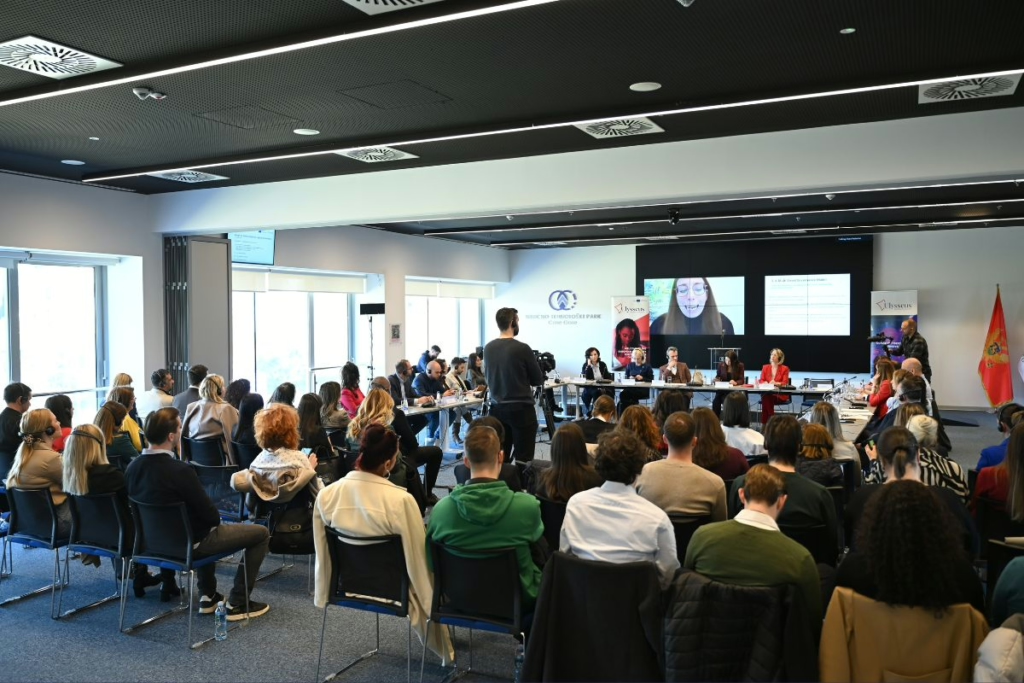
The expert part of the event was moderated by Dr. Andreja Mihailović, Manager of the Ulysseus Innovation Hub for Cybersecurity, who emphasized that the European regulatory approach is rapidly shifting from reactive content control to preventive transformation of digital service design. “Attention has become currency, and children should not be collateral in that economy,” Mihailović noted, reminding that the European Parliament Resolution of November 2025 confirms this direction, insisting on a harmonized digital age limit, a ban on profiling minors, and stronger enforcement of the Digital Services Act.
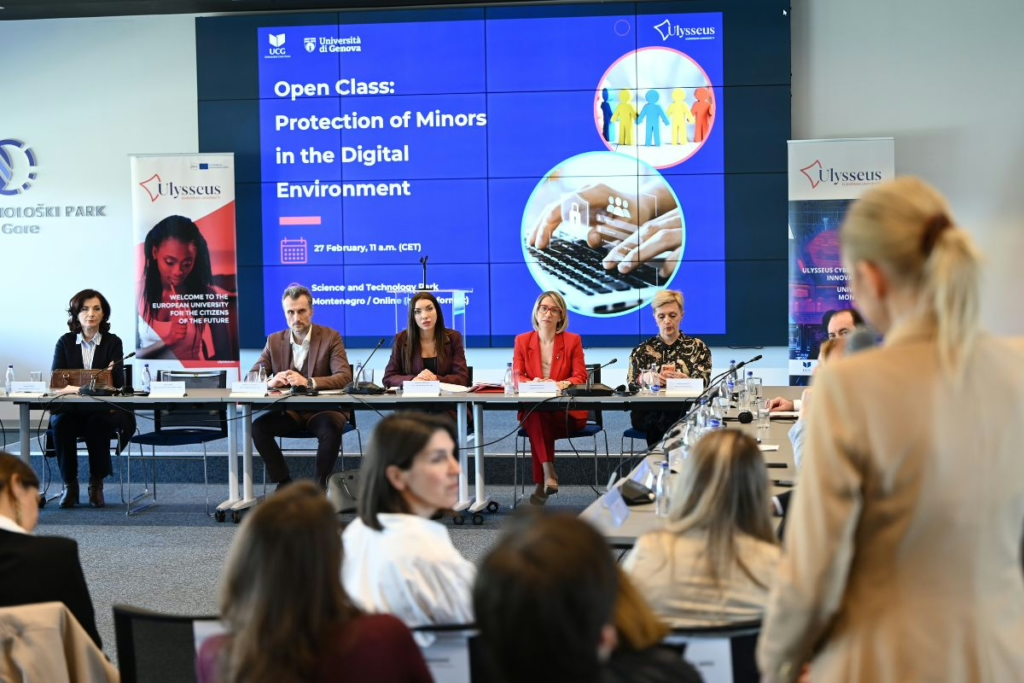
Dr. Clara Pastorino from the University of Genoa contributed a comparative dimension to the discussion by presenting the Italian experience in implementing legislative solutions aimed at protecting minors in the digital environment. According to national legislation, minors aged 14 can independently consent to the processing of their personal data in relation to digital services. Below that threshold, parental consent is required. There is no general ban on the use of social networks under the age of 13; the system relies on consent rules combined with mandatory protective measures imposed on service providers.
The Caivano Decree introduced a significant innovation: providers of electronic communications must ensure that parental control tools are available and directly integrated into their service contracts. It is regulated that SIM cards registered to minors must include mandatory blocking of inappropriate content. Furthermore, there is a complete ban on access to pornographic content for children, with an effective age verification system implemented. Pastorino concluded that Italy positions itself as a regulatory laboratory in Europe. The shift from prevention based on education to technologically imposed responsibility of service providers marks a transition from ineffective self-regulation to structured co-regulation, in line with the EU strategy “Better Internet for Kids.”
Prof. Angela Celeste Taramasso (UNIGE) reminded participants that an event like this exemplifies the mission of the European University Ulysseus, which relates to university engagement in the community and the promotion of values of equality, diversity, and inclusion.
Participants emphasized that the digital environment in which children grow up cannot be left solely to market logic and algorithmic engagement models, but must be governed by clear and applicable rules that protect their rights and development.
It was concluded that the protection of minors in the digital space represents a matter of regulatory responsibility and institutional maturity, and the constructive discussion confirmed the readiness of the expert and institutional community to contribute, through reasoned dialogue, to the establishment of a sustainable and European-aligned legislative framework. The proposers of the law stressed that the arguments and suggestions of the round table participants will be significantly incorporated into the improvement of the legislative solution.
Dr. Clara Pastorino’s presentation can be downloaded from the attachment.
About Ulysseus
Ulysseus is one of the 73 European Universities alliances selected by the European Commission under its flagship initiative of the European strategy for universities. These alliances, co-funded by the European Commission, bring together almost 650 higher education institutions of all types from across Europe. Led by the University of Seville, the Ulysseus European University Alliance encompasses seven other partner universities: the Université Côte d’Azur (France), University of Genoa (Italy), the Technical University of Košice (Slovakia), MCI | The Entrepreneurial School® (Austria), Haaga-Helia University of Applied Sciences (Finland), the University of Münster (Germany), and the University of Montenegro (Montenegro).