





Being Authentic in the Age of Appearances
What does trust look like in a digital environment shaped by algorithms, polished profiles, and AI-generated voices?
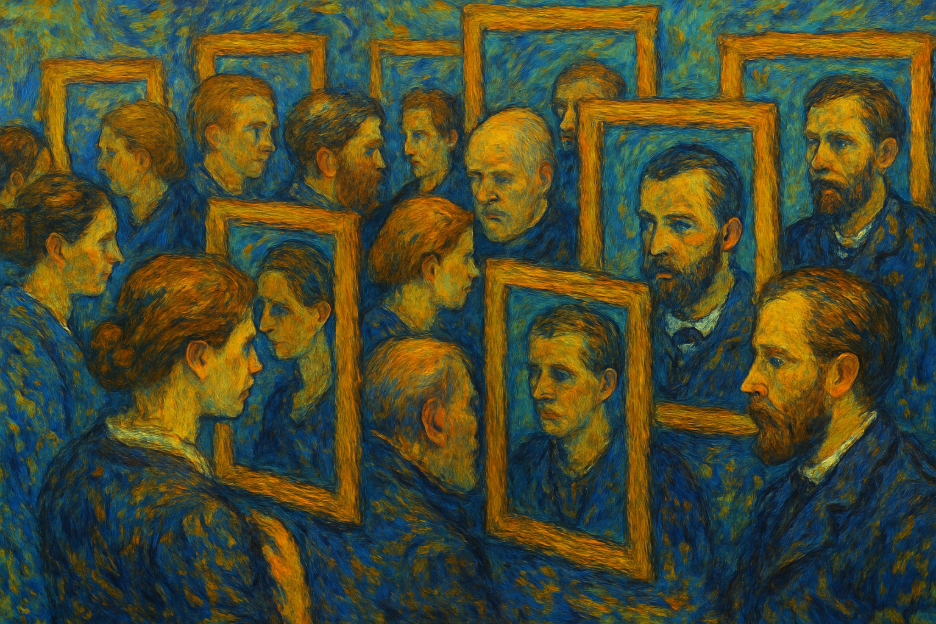
Image courtesy: ChatGPT 5.0
How do we know if something is true and how can we trust it?
This publication is written by: Kanan Dhru, Sari Korhonen and Igor Jovansevic as part of the Ulysseus satellite project METACOG.
In an online world overflowing with information, these questions have quietly become philosophical again. Truth is no longer shaped only by facts; it is about the perceived trustworthiness of the person and the manner they present them. But what does trust look like in a digital environment shaped by algorithms, polished profiles, and AI-generated voices?
Authenticity, once a quiet moral virtue, has turned into a performance. We are told to “be ourselves,” yet are often rewarded for being the most appealing version of ourselves. The line between being and appearing authentic has blurred. To speak one’s mind online feels risky, and to stay politically correct feels safe, unless the intention is to provoke in the first place.
So, we construct curated selves that seem spontaneous but are carefully managed. Why is it so frightening to say what we actually mean? Because authenticity demands vulnerability and it exposes the self to judgment. At the same time, the online spaces sometimes amplify the loudest voices rather than the more thoughtful ones – those with extreme views often speak freely, while more responsible voices hesitate to enter the conversation.
The flood of synthetic content, deepfakes, and AI-generated narratives has made us suspicious of everything, even of genuine emotion. We have begun to scroll past voices that sound too polished, too strategic, too perfect. What we long for is not mere information, but original presence – someone thinking, feeling, and erring in real time.
Critical thinking, then, is not just analysis; it is also an act of courage. It is the willingness to pause, to question, and to discern meaning from data. Information can be copied endlessly, but knowledge is always embodied. It lives in human context, emotion, and ethical intention.
Perhaps being authentic today means not chasing originality but reclaiming sincerity. To speak with awareness, to doubt what we read, and to care about what we share. In that small act of mindful expression, we move closer to truth -not only in scientific terms, but the kind that can still be trusted.
About METACOG
METACOG is an EU-funded AI literacy programme designed to combat disinformation and fake news by promoting civic engagement and shared European values.
The initiative aims to strengthen citizens’ ability—particularly among higher education students and teachers—to recognize and respond to disinformation through an innovative curriculum, AI-based tools, and best practices.
By acknowledging the dual role of artificial intelligence in both generating and countering disinformation, METACOG seeks to empower individuals with the critical thinking and digital literacy skills essential for navigating today’s information landscape.
Targeting higher education institutions, government and non-governmental organizations, media professionals, and the general public, METACOG is led by Haaga-Helia University of Applied Sciences (Finland) in collaboration with the Technical University of Košice (Slovakia), the University of Montenegro (Montenegro), and The Hague University of Applied Sciences (The Netherlands). The project is funded under the Erasmus+ Programme (KA220-HED) and will run from 1 September 2024 to 31 August 2027.