



Short term mobility: Energy Communities for Smartcities

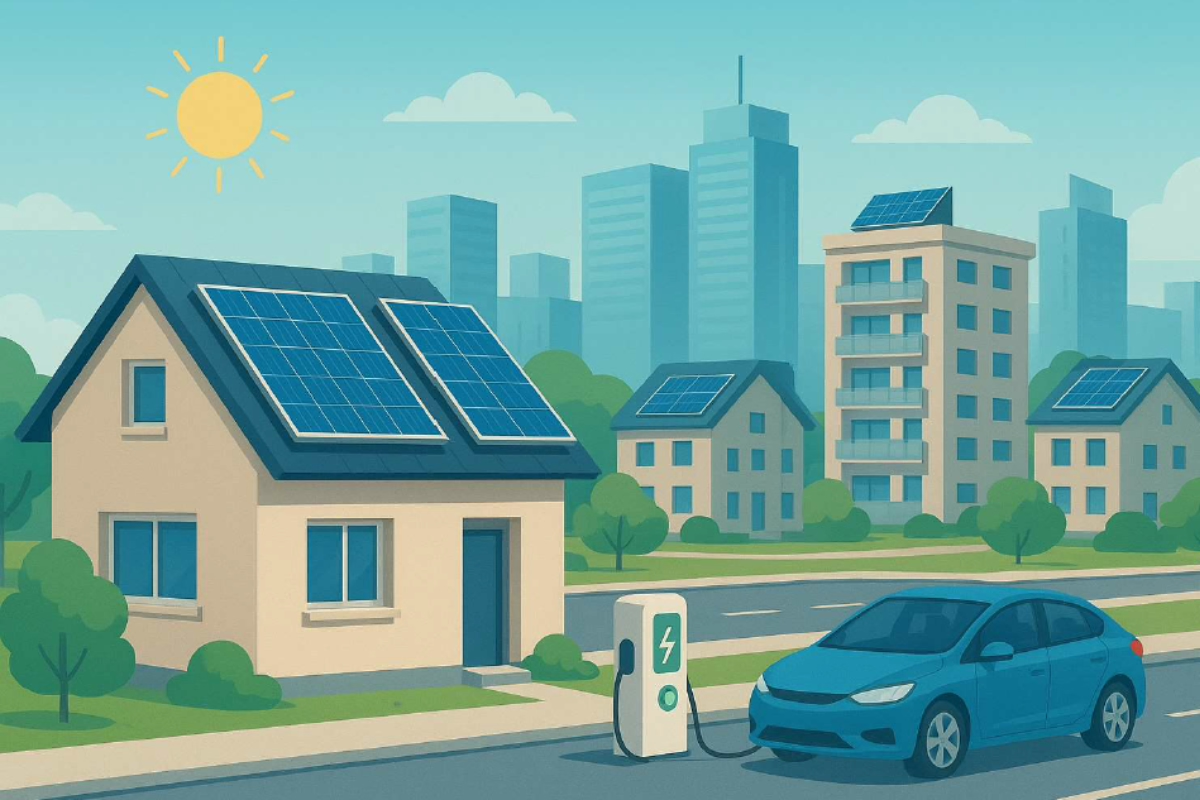
This short term mobility offers both students (undergraduate, master, and PhD) and researchers a dynamic and inspiring learning experience on the design and analysis of energy communities in the context of smart cities. The program focuses on learning centered on the development of use cases that consider energy communities made up of different participants: photovoltaic electricity generation, electrical and/or thermal storage systems, electric vehicles, and flexible demand.


All of this considers different types of cities, whether in urban or rural environments. Different regulatory issues, as well as the technical analysis and economic evaluation of the different types of energy communities, are addressed through work in small interdisciplinary groups, enabling active and comprehensive learning.


Please be aware that your home university may set a different application deadline depending on their internal selection process.
Registration dates 01 October 2025 16 January 2026
Course dates 23 February 2026 27 February 2026
Registration is open
Short term mobility: Energy Communities for Smartcities

Course Outline

This short term mobility is structured around a blended learning approach that combines virtual sessions with an intensive in-person week. Participants will work both individually and in international multidisciplinary teams, focusing on the design and analysis of energy communities in smart city environments.

During the virtual phase, students will explore the use and integration of renewable resources, shared self-consumption, and European regulatory aspects related to energy communities.

In the physical phase, students will be introduced to the administrative considerations of energy communities and will learn from experts in the field about the lessons learned in the processing and operation of energy communities. Subsequently, working in groups, students will learn to design energy communities that incorporate both renewable resources and elements of energy storage and electricity use. Finally, students will carry out a technical and economic analysis of the energy communities they have designed. These analyses have to be presented to the rest of audience.

Course Content

  • Introduction to European and local regulations related to energy communities.
  • Quantification of renewable resources based on location and architectural integration.
  • Calculation of electrical energy produced by photovoltaic fields.
  • Uses of electrical and thermal energy storage systems in energy communities.
  • Considerations regarding charging points for electric vehicles in energy communities.
  • Economic aspects related to energy communities.

Learning Outcomes

Following this course, students will be able to:

  • Ability to conceptually design an energy community in city environments.
  • Understanding of the technical and economic parameters that affect an energy community.
  • Ability to quantify renewable energy resources.
  • Work collaboratively in multicultural teams, applying problem-solving and creativity.
  • Present their work effectively in a public forum to both academic and industry audiences.

Physical Mobility

The physical mobility will take place from 23 to 27 Febraury 2026 at the School of Engineering, University of Seville (Camino de los Descubrimientos S/N, 41092, Seville).

The programme combines morning and afternoon sessions, offering a full-time, immersive experience. Activities will include:

  • Lectures and seminars on the design and analysis of energy communities
  • Practical workshops on simulation tools for renewable resources and energy communities
  • Teamwork sessions to develop group projects
  • Discussions on energy communities
  • Guided city tour and cultural activities
  • A final business and research forum where participants will present their projects to a panel of experts
  • A field visit to an energy community (TBD)

Agenda

Day 1

Morning

09:30-10:00 Registration
10:00 – 13:00 Welcome and Group Dynamics.
Presentation of the short term mobility programme, professor and participants.
Activities focused on group integration and intercultural exchange.
11:00-11:30 Coffee Break

Afternoon

13:00 – 14:00 Lunch
14:00 – 15:30 Introduction to regulations of energy communities
15:30 – 17:00: Lessons learned in the administrative procedures and implementation of an energy community

Day 2

Morning

09:30 – 13:00. Definition of energy communities and use cases. The groups will work under predefined conditions regarding the type of energy community and its location.
11:00-11:30 Coffee Break

Afternoon

13:00 – 14:00: Lunch
14:00 – 17:00: Tour of the city of Seville. Guided visit to emblematic sites in Seville, including historical, cultural, and economic insights.

Day 3

Morning

09:30 – 13:00 Quantification of renewable resources. The groups will calculate the solar resource, considering the location of the energy community and the architectural possibilities of the buildings.
11:00-11:30 Coffee Break

Afternoon

13:00 – 14:00: Lunch
14:00 – 17:00. Design of the conceptual scheme of the energy community, the equipment and systems used, and the calculation of their dimensions.
19:00 Cultural Activity (TBC)

Day 4

Morning

9:00 – 18:00 Techno-economic analysis of the energy communities designed by groups. Preparation of presentations.
11:00-11:30 Coffee Break

Afternoon

20:00 – 22:00 Farewell Dinner. Informal networking event to close the programme.

Day 5

Morning:

09:30 – 13:00. Project presentations by student teams to a panel of academic and industry experts.

Afternoon:

13:00 – 14:00: Lunch
15:00-17:00. Field visit (TBD)


Virtual Component

Dates: 09/02/2026 to 11/02/2026 (TBC)
Format: Two live online sessions and autonomous work (total: 5 hours)

Organization:
The virtual component will be delivered synchronously via MS Teams. Access links and schedule details will be provided one week in advance. Participation is mandatory for all selected students and staff.

Content:
This phase is designed to foster initial interaction and ensure all participants share a common understanding before the on-site activities begin.
The sessions will serve as an introduction to the programme. They will include:

  • Presentation of the course structure and objectives.
  • Introduction of teaching staff and participants.
  • Overview of key concepts in renewable energy sources, photovoltaic technology, energy storage systems, heat pumps and electric networks.

Requirements

To be eligible for this short term mobility, participants must meet the following requirements.

Academic Level:

  • Bachelor’s degree students
  • Master’s degree students
  • PhD candidates
  • Alternatively, early-stage researchers or academic staff may participate if selected by their home institution

Academic Background:

The short term mobility is aimed at individuals studying or working in areas related to:

  • Energy engineering
  • Electrical and electronic engineering
  • Industrial engineering

Language Proficiency:

  • Minimum English level: B2 (CEFR)
  • Recommended: C1, especially for academic staff or participants intending to contribute to research discussions
  • Participants must be able to follow lectures, engage in teamwork, and present their final project in English.

Application Process

The selection is done by your home institution.

  • Mobility agreements must be sent before the vitual mobility.
  • 4-5 places per university, but unused slots may be given to other universities.

Professors

  • Francisco Javier Pino Lucena (University of Seville) – Short Term Mobility Coordinator
  • Esther Romero Ramos (University of Seville)

More information