Open Lecture Series | Wellbeing in Smart Cities: KPI & Local Policies

Open Lecture Series | Wellbeing in Smart Cities: KPI & Local Policies

Welcome to the Ulysseus Open Online Lecture Series!

In just 30 minutes, gain valuable insights and practical perspectives in an engaging, online format. This online event is open to all participants from our 8 Ulysseus partner universities.


Join us live, from anywhere, and let new ideas move you.


About this Open Series Lecture

The lecture “Wellbeing in Smart Cities: KPI & Local Policies” examines how qualityoflife data indicators, urban scenarios, and participatory methodologies can guide more inclusive and evidencebased urban policies. By juxtaposing the Italian and Japanese state‑of‑the‑art, the session highlights complementary approaches to measuring urban wellbeing and the potential of integrated analytical systems for understanding contemporary urban complexity.

The session opens with the case study of “Controllo Dynamico”, a urban dashboard that dynamically integrates 160 open‑data on urban environment, infrastructure, society, and economy, enabling comparative assessments of attractiveness, inclusiveness, and development across major Italian cities.

Then the Japanese Liveable Wellbeing City Indicators project, which combines objective measures of service quality with subjective perceptions of happiness and life satisfaction, revealing a innovative measurement system of wellbeing.

Following the case study of “SEAGUL”, a prototype multilayer dashboard that transforms sub‑municipal georeferenced data into indicators and scenarios supporting local governance and proximity‑based policies.

Finally, an outline of the role of codesign and Living Labs processes in capturing the nuanced “voice” of local territories, translating emerging evidence into targeted actions and policies through structured co‑design processes and active citizen engagement. This activity involves also Ulysseus WP6 Equality, Diversity and Inclusion (EDI) and Community Engagement.

Programme

  • Controllo Dynamico: a dashboard for quality of life measurement and benchmarking in cities by Renata Paola Dameri (University of Genoa)
  • The Measurement System for Individual Wellbeing in Japanese Cities by Takehiko Nagumo (Keio University Graduate School of Media and Governance, Representative Director of Smart City Institute Japan)
  • From the City to the Neighborhoods: The “SEAGUL” Dashboard by Monica Bruzzone (University of Genoa)
  • Turning Data Into Local Action. Policy Design at the Neighborhood Level by Nicola Canessa (University of Genoa, President of Genova Smart City Association)
  • Opening and final remarks by Chiara Centanaro (University of Genoa)

This online free event is open to all participants from our 8 Ulysseus partner universities: take this opportunity to gain insights you can apply right away!

About Ulysseus Open Series

Speakers

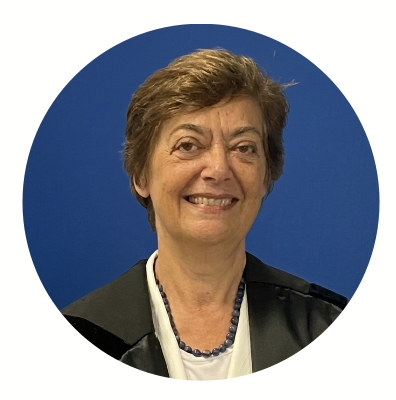
Renata Paola Dameri

Photo of Renata Dameri

Renata Paola Dameri is Professor of Business Administration at the University of Genoa (Italy). She has more than 25 years of experience in teaching and research in fields such as smart cities, information systems, managerial accounting, and cultural heritage management. Prof. Dameri is Vice Rector for International relations and advisor for the Municipality of Genoa in topics such as smart cities, circular economy, and urban dashboards.

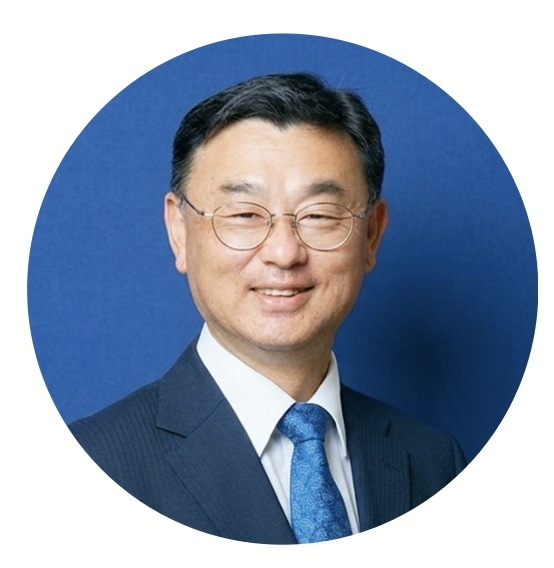
Takehiko Nagumo

Photo of Takehiko Nagumo

Takehiko Nagumo is professor at Keio University Graduate School of Media and Governance, Kyoto University Graduate School of System Design Management, Kyoto University Graduate School of Management, and Yokohama City University. He is the Representative Director of the Smart City Institute Japan. Concurrently, he serves as the Senior Executive Managing Officer of Mitsubishi UFJ Research and Consulting, Ltd. Takehiko is also a member of the Well-Being Indicator Committee under the Digital Agency, a member of the UN-Habitat Global Quality of Life Initiative Assurance Panel, and a policy advisor to the Tokyo Metropolitan Government, Shibuya Ward, Yokohama City, Kamakura City, Hamamatsu City, Aizuwakamatsu City, and several other local governments.

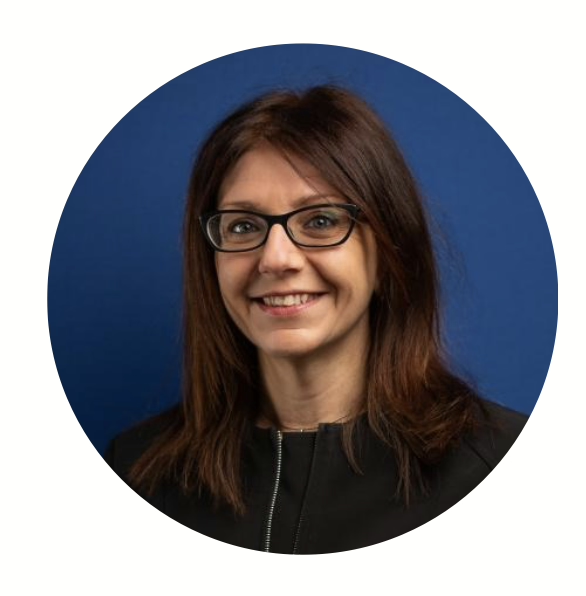
Monica Bruzzone

Photo of Monica Bruzzone

Monica Bruzzone is an Architect and Researcher at the University of Genoa (Italy). Leading trainig courses on sustainable and circular cities, smart city design and the digital transition of urban and cultural heritage systems. She integrates academic research with professional issues focusing on urban regeneration and cultural landscapes, and developing evidence‑based policy tools and dashboards to support decision‑making in enhancing the quality of life in cities and regions.

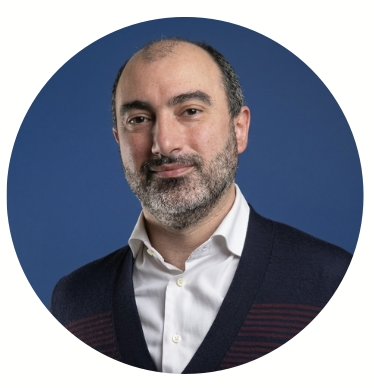
Nicola Canessa

Photo of Nicola Canessa

Architect and PhD, is Associate Professor in Urban Planning at the Department of Architecture and Design of the University of Genoa, where he coordinates the GIC-Lab. His research focuses on the transformation of contemporary cities and territories. He is Co‑Principal Investigator of the PR‑FESR Mobiquity project, Adjunct Component of RAISE Ecosystem, since 2025 he is President of the Genova Smart City Association.

Chiara Centanaro

Chiara Centanaro is an architect, PhD, and research fellow in Urban Planning at the Department of Architecture and Design of the University of Genova, where she also teaches as adjunct professor. She is a member of the GIC-Lab research group and part of the critical mass of the RAISE project (Robotics and AI for Socio-economic Empowerment), within the National Recovery and Resilience Plan. Her research focuses on the relationship between digital technologies and urban design, with particular attention to participatory co-design processes, Living Lab methodologies, and strategies for urban resilience.

Learn how quality‑of‑life data indicators, urban scenarios, and participatory methodologies can guide more inclusive and evidence‑based urban policies. Join us!