


European Researchers’ Night 2025

European Researchers’ Night 2025

Ulysseus launches a series of concise expert interviews in collaboration with partner universities, focusing on the development of climate-neutral and smart cities within the framework of the EU Mission: Climate-Neutral and Smart Cities. These brief yet informative dialogues aim to elucidate key urban challenges, the transformative role of technology, and the importance of citizen engagement in sustainable urban development.


The initiative seeks to foster greater public understanding of scientific knowledge and to encourage active societal involvement in sustainability efforts. The interviews will be disseminated through Ulysseus’ official social media platforms and YouTube channel.


The European Researchers’ Night — an annual event coordinated by Marie Skłodowska Curie Actions (MSCA) which aims at bringing research and researchers closer to the public and to showcase the impact of their work on people’s daily life. The initiative will combine face-to-face and online activities celebrated across more than 300 cities in Europe.

 

Rethinking Our Cities: Smart, Green, and For Everyone

Reflections on Building Smart and Climate-Neutral Cities

Within the framework of the European Union’s “Climate-Neutral and Smart Cities Mission,” the Ulysseus European University is launching a series of micro-interviews with researchers and experts from the alliance’s partner universities. This initiative aims to bring key challenges and opportunities related to the urban transformation towards more sustainable, resilient, and inclusive models closer to the general public.

Through concise and accessible contributions, the interviews will provide a clear understanding of what it means to live in a net-zero emissions city, the role of technology in enhancing urban quality of life, and the significance of citizen participation in ecological transition processes. They will also address critical issues such as current barriers to climate action, the most promising innovations in urban contexts, and strategies to ensure a just transition that leaves no one behind.

Drawing on concrete and inspiring examples from European cities, the series seeks to foster dialogue between science and society, promoting critical awareness and active engagement with the pressing challenges of urban sustainability in Europe.

On European Researchers' Night

This activity is part of the European Researchers’ Night. This is an annual, continent-wide event dedicated to celebrating science and bringing researchers closer to the public. Held every September, this initiative provides an opportunity for people of all ages to engage with science through a variety of activities, including interactive experiments, exhibitions, science shows, and discussions. The event is designed to spark interest in research careers among young people, demonstrating the impact of scientific work on everyday life and society. Organized by universities, research institutions, and museums across Europe, the night aims to demystify the work of scientists and make it more accessible and exciting for the general public.

About the EU Cities Mission

EU Missions

EU Missions are large-scale initiatives under Horizon Europe designed to tackle major global challenges, such as climate change, cancer, soil health, ocean restoration, and the development of climate-neutral and smart cities. They set clear, time-bound goals and bring together research, policy, and stakeholders to drive innovation and deliver concrete solutions for societal benefit.

The Cities Mission

The Cities Mission supports 112 cities in their journey to climate neutrality by 2030, positioning them as pioneers of urban transformation. These cities serve as innovation hubs for testing and scaling solutions that will enable all European cities to achieve climate neutrality by 2050. Targets: z 100 climate-neutral and smart cities by 2030 z Ensure that these cities act as experimentation and innovation hubs to enable all European cities to follow suit by 2050.

Key Achievements

  • 112 cities selected as frontrunners in climate neutrality – they are developing Climate City Contracts and receiving tailored support and help with access to funding.
  • Cities have set out to achieve 200 million tons CO₂eq (carbon dioxide equivalent) reduction, equal to the emissions of the Netherlands and Croatia combined.
  • Mission Cities engages local stakeholders and citizens, gathering on average 40 co-signatories per Climate City Contract.
  • Member States are establishing national support structures – Romania, for example, allocated EUR 300 million to its 3 mission cities and 10 additional cities.
  • The European Investment Bank offers financial advisory services and a €2 billion lending envelope.

Source: Factsheet EU missions, climate-neutral and smart cities, July 2025

To whom is this initiative addressed to?

«Rethinking Our Cities: Smart, Green, and For Everyone» brings scientific knowledge on urban sustainability closer to everyone in a clear and accessible way. Together, we can better understand the challenges and explore smart, climate-neutral solutions for our cities.

By participating, you’ll help build an informed, active, and committed community, driving the ecological transition toward healthier, smarter, and more sustainable urban spaces.

Interviews with Ulysseus scientists

Here, in this section, we will feature the interviews of all Ulysseus scientists. These interviews will be gradually published during the week of 19-26 September 2025.

Our Smart Cities Experts

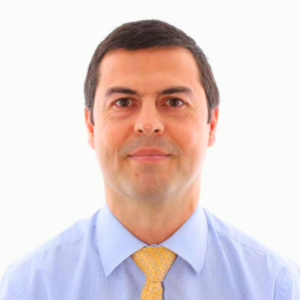
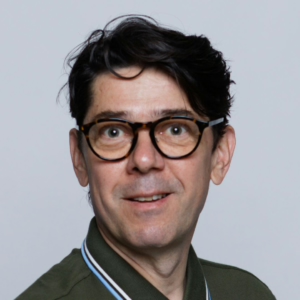
Alfredo Iranzo Aparicio

University of Seville

Dr. Alfredo Iranzo is a Chemical Engineer (University of Zaragoza, 2000), MSc (2010) and PhD (2011, Extraordinary Doctorate Award) in Thermal Energy Systems from the University of Seville. He began his career at ANSYS Germany (Munich) as a CFD expert, later joining AICIA and now serving as faculty at the Energy Engineering Department, University of Seville.

He has authored 70+ JCR articles (h-index 27), supervised four PhDs, and contributed to 15 publicly funded projects and over 50 industry contracts, focusing on hydrogen technologies and energy engineering.

Dr. Iranzo serves on the Management Board of the EERA Joint Program on Fuel Cells and Hydrogen, is Associate Editor of the International Journal of Hydrogen Energy (Elsevier), and on the Editorial Board of Engineering Applications of Computational Fluid Mechanics (Taylor & Francis). He is currently Chief Scientific Officer of the University of Seville Innovation Hub on Sustainable Energy, Transport, and Mobility within Ulysseus European University.


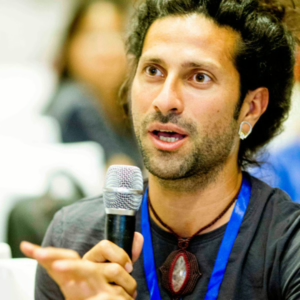
Eliesh Sahyoun

Université Côte d’Azur

A lifelong learner and experimental thinker, Eliesh Sahyoun is an Architect, Urban Planner, and Sustainable Transition & Foresight Expert dedicated to reimagining the future of human habitats. Blending academic insight with hands-on practice, Eliesh approaches design, planning, and transformation through innovation, biomimicry, and interdisciplinary experimentation. As a Lecturer, Performer Philosopher, and founder of ODDD activities, Eliesh fosters participatory change by championing collaboration, creativity, and global citizenship. Passionate about sustainability, Eliesh works with cities, territories, and organizations to envision and implement transformative strategies that dissolve boundaries and pave the way toward inclusive, resilient, and future-ready communities.

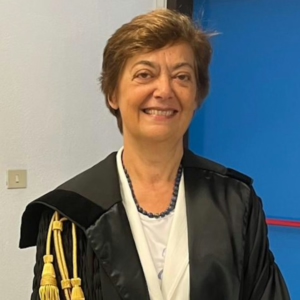
Renata Dameri

University of Genoa

Renata Paola Dameri is Professor in Business Administration and Vice Rector for International Relations and Smart cities at the University of Genoa. Her research interest in Smart city has lasted since 2010, when she wrote the seminal paper «Searching for smart city definition: a comprehensive proposal», which has now over 1.000 citations. She is director of the short master in Smart city planning and member of the Board of the Genoa Smart City Association. She has been Deputy Mayor for Social policies at the Municipality of Genoa and consultant to OECD and EU for smart and inclusive cities.

Oliver Som

MCI, The Entrepreneurial School

Prof. Dr. Oliver Som is a researcher, author, and thought leader specializing in future-proof innovation strategies and the innovation behaviour of SMEs. With extensive experience in innovation and technology management, he has led and contributed to numerous applied research projects bridging industry needs and policy development. His work focuses on innovation management, sustainable innovation, innovation ecosystems (such as Smart Cities), futures thinking, and the analysis of digital technologies adoption. Oliver combines rigorous empirical research—both quantitative and qualitative—with hands-on facilitation of workshops, focus groups, and academic lecturing to drive practical, forward-looking solutions in complex innovation ecosystems.

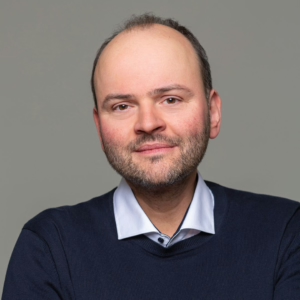
Pierantonio Silvani

Haaga-Helia University of Applied Sciences, Finland

Pierantonio Silvani holds a Master of Science in Economics and Information Technology and is currently a Ph.D. candidate researching user-centred design of information systems in smart city contexts. His academic and professional background integrates business, design, and digitalisation, with a focus on interdisciplinary approaches to digital transformation. As a Senior Lecturer at Haaga-Helia UAS, he teaches and develops curricula in digital services and digital business innovation while actively engaging in research and development projects. His work emphasises the role of inclusive and sustainable technologies in urban environments.
Pierantonio is also committed to science outreach and internationalisation, supporting initiatives that encourage global collaboration and promote IT careers among international students.

Marija Jevrić

University of Montenegro, Montenegro

Marija Jevrić, Dr-Ing., educated in the field of civil engineering at the University of Montenegro (Dipl-Ing. PhD) and the field of urbanism at the University of Belgrade (Master), is an assistant professor at the Faculty of Civil Engineering in courses including Introduction to civil engineering, Geometry, Civil engineering structures. Her research interests include urban water management, waste management, green buildings, green infrastructures, and natural-based solutions. She actively participated in Erasmus CBHE projects and has led one related to climate-smart and sustainable urban development; she also led and participated in other EU-funded projects, as well as bilateral and national scientific research projects. Marija is a member of the Board of Ambassadors for the BUILD UP platform – European Commission initiative that focuses on promoting energy efficiency in building.

Related news